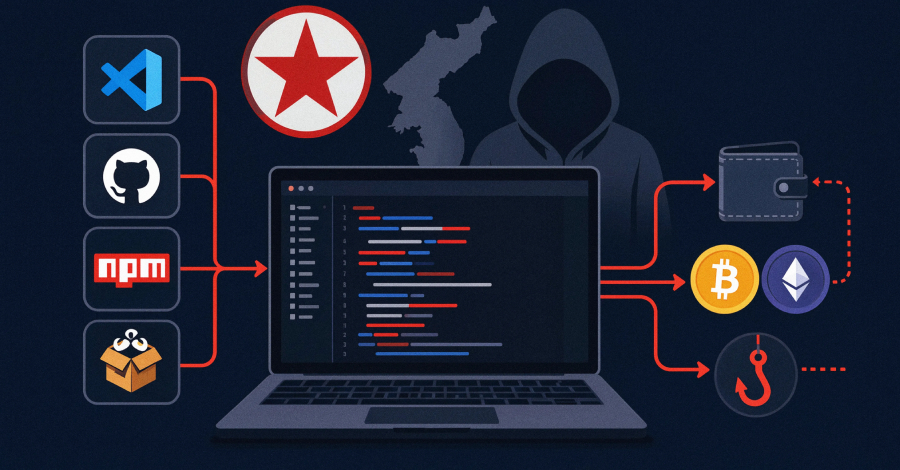
Cybersecurity researchers have uncovered an evolving wave of campaigns linked to North Korean state-backed threat actors that are increasingly abusing developer tools and software ecosystems to distribute malware and steal cryptocurrency and sensitive credentials.
The activity is associated with a persistent threat cluster known as Contagious Interview, also tracked under aliases such as Famous Chollima, HexagonalRodent, and Void Dokkaebi.
Phishing Campaigns Masquerading as Job Offers and Code Reviews
According to research published by Proofpoint, the group has been conducting large-scale phishing operations targeting developers across nearly 100 organizations worldwide.
Industries affected include:
- Cryptocurrency and blockchain firms
- Financial services organizations
- Technology companies
- Academic and research institutions
The campaign—tracked as UNK_DeadDrop—relies heavily on fake recruitment messages and coding assignments designed to lure software developers into opening malicious repositories.
GitHub Lures Used to Deliver Multi-Platform Malware
Attackers typically send emails containing links to fake or compromised GitHub repositories posing as:
- Technical job assessments
- Code review tasks
- Cryptocurrency development projects
Victims are instructed to clone repositories and open them in development environments such as Visual Studio Code or Cursor.
Once opened, the repositories trigger hidden scripts that deploy malware across:
- Windows systems
- macOS devices
- Linux environments
Researchers identified the use of an open-source framework known as Overlord, adapted for malicious purposes.
VS Code Exploits Enable Silent Code Execution
A key tactic in the campaign involves abusing VS Code project settings using a configuration technique known as “runOn: folderOpen”, which automatically executes code when a project is opened—without requiring user interaction.
This method allows attackers to:
- Install malware loaders silently
- Execute system-specific payloads
- Avoid traditional user-triggered execution warnings
Security analysts note that this technique has become a preferred method for North Korean-linked operators since late 2025.
Malware Designed for Credential and Crypto Theft
The infection chain typically begins with lightweight loaders written in shell scripts or VBScript, depending on the operating system.
These loaders install malicious extensions disguised as legitimate development tools, enabling attackers to:
- Steal browser-stored credentials
- Extract cryptocurrency wallet data
- Capture system information
- Execute remote commands
A custom variant of the Overlord framework is often deployed for persistent access and data exfiltration.
Targeted Data Theft via Fake Developer Tools
The malware campaign specifically focuses on high-value digital assets, including:
- Crypto wallet extensions
- Developer credentials
- Cloud access tokens
- Source code repositories
Data is exfiltrated to attacker-controlled servers via HTTP-based communication channels.
Unlike traditional malware, some Windows variants perform one-time data collection before removing traces, reducing detection likelihood.
Expanding Supply Chain Threats in Developer Ecosystems
Security researchers also reported parallel activity involving malicious extensions and packages distributed through developer marketplaces, including:
- Fake Visual Studio Code Marketplace extensions
- Compromised npm packages
- Trojanized GitHub repositories
Some malicious extensions impersonate legitimate productivity tools while secretly enabling remote command execution and data theft.
Shift Toward Industrialized Cyber Operations
Experts say the campaign reflects a broader evolution in North Korean cyber operations, moving from small-scale social engineering attacks to more industrialized, automated delivery systems.
Key developments include:
- Increased use of developer-focused phishing campaigns
- Abuse of open-source collaboration platforms
- Integration of multi-stage malware loaders
- Expansion into cloud-based command-and-control infrastructure
Researchers also note overlaps with earlier North Korean malware families such as BeaverTail and OtterCookie, indicating a growing and modular cybercrime ecosystem.
Growing Financial Motivation Behind Attacks
Security firms estimate that North Korean-linked cyber operations continue to focus heavily on cryptocurrency theft due to economic sanctions restricting traditional revenue streams.
Recent campaigns have reportedly led to:
- Millions of dollars in stolen digital assets
- Thousands of compromised developer systems
- Large-scale theft of wallet credentials and authentication tokens
Conclusion
The latest findings highlight a major shift in cyber threat tactics, where trusted developer tools and workflows are being turned into attack vectors. By embedding malware inside GitHub repositories and IDE configurations, North Korean-linked actors are blurring the line between legitimate development activity and cyber intrusion.
Organizations are urged to closely monitor developer tool usage, audit repository integrity, and enforce strict controls around code execution environments.