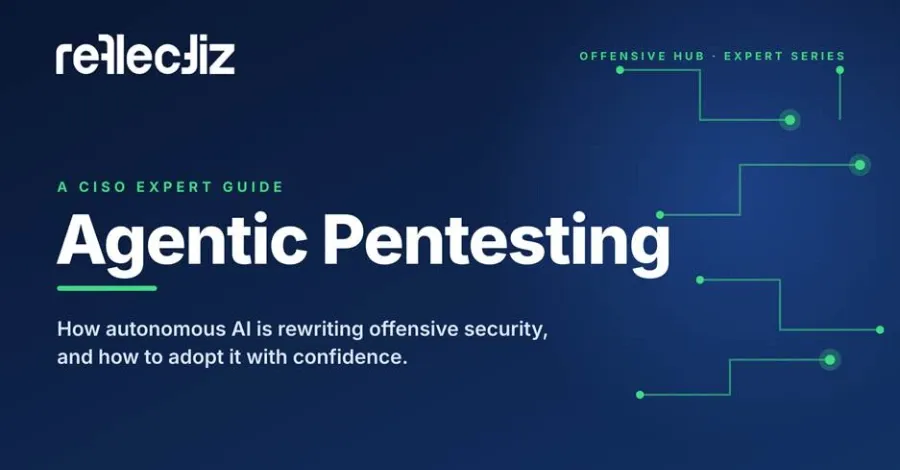
The growing speed of vulnerability exploitation is putting pressure on organizations to rethink traditional penetration testing. Security teams that assess websites only periodically may struggle to keep pace with attackers who can identify and weaponize weaknesses within days.
A new guide for security leaders examines how agentic AI-powered penetration testing can provide more continuous coverage of web applications while helping organizations validate vulnerabilities without unnecessarily exposing production systems to dangerous exploit code.
The Growing Gap Between Exploitation and Patching
Recent industry data highlights the difference between how quickly vulnerabilities can be exploited and how long organizations often take to remediate them.
The 2026 Verizon Data Breach Investigations Report identifies vulnerability exploitation as a leading initial-access method, while research from Google Mandiant has indicated that attackers can move from vulnerability disclosure to exploitation in roughly days rather than weeks.
At the same time, vulnerability remediation can take considerably longer.
This creates a window in which a weakness may be known publicly but remain exploitable in an organization’s environment.
Traditional penetration tests, which are commonly conducted on a scheduled basis, may not provide sufficient coverage as applications and infrastructure change continuously.
Why Conventional Security Scanners Can Miss Business Logic Flaws
Automated vulnerability scanners are effective at identifying many known technical weaknesses, but they can struggle with vulnerabilities that depend on application-specific logic.
One example is an Insecure Direct Object Reference (IDOR) vulnerability.
An application may allow a logged-in user to modify a request containing an account identifier without properly verifying whether that user owns the referenced account.
Exploiting such a flaw can require multiple legitimate actions rather than a conventional malicious payload.
A basic scanner may therefore overlook the vulnerability because it does not understand the application’s intended authorization relationships.
A manual penetration tester may identify the problem, but the assessment is generally limited to the assets and functionality included within that engagement.
Agentic testing attempts to approach the problem differently by allowing an AI-driven system to explore application functionality, understand relationships between actions and data, and test multi-step attack scenarios.
What Agentic Pentesting Adds
Agentic penetration testing uses autonomous AI systems to perform security testing tasks with less continuous human intervention.
Instead of simply sending predefined payloads, an agent can potentially:
- Navigate websites through a real browser
- Maintain authentication and session state
- Explore application functionality
- Identify relationships between users and resources
- Construct multi-step attack paths
- Adapt testing strategies based on application responses
- Recheck previously identified weaknesses
- Validate whether a suspected vulnerability can actually be reproduced
This approach is intended to provide broader and more frequent testing than conventional point-in-time assessments.
Continuous Testing Can Improve Visibility
Web applications can change substantially between scheduled penetration tests.
New endpoints, features, authentication flows and integrations may be introduced after an assessment has been completed. As a result, a previously accurate security assessment can become outdated.
Continuous testing aims to address this problem by repeatedly assessing the application and checking whether previously identified security conditions remain fixed.
The objective is not simply to generate more vulnerability findings, but to provide evidence about which security weaknesses are actually present and reproducible.
Three Important Characteristics of Agentic Testing Platforms
The guide identifies several architectural characteristics that organizations should examine when evaluating AI-powered penetration-testing solutions.
1. Measurable Test Coverage
Allowing an AI model to decide entirely what it wants to test can create unpredictable coverage.
Security teams should instead look for systems that establish a defined testing matrix before execution. Each relevant endpoint and attack category should become a trackable work item.
The AI can then adapt its testing technique while still being required to complete the defined coverage.
2. Independent Finding Validation
AI-generated security findings can contain false positives.
One proposed solution is to use a separate validation agent that independently attempts to reproduce a suspected vulnerability before it is added to the final report.
Separating discovery from validation can reduce the amount of manual triage required from security analysts.
3. Browser-Based Testing
Modern web applications frequently rely on JavaScript, dynamic interfaces, authentication workflows, MFA and anti-automation controls.
Tools that operate primarily through basic HTTP requests may not fully reproduce the behavior of a real user.
A browser-capable testing agent can interact with applications in a way that more closely resembles an actual user, allowing it to investigate security issues hidden behind dynamic workflows and business logic.
AI Pentesting Requires Strong Controls
An autonomous security-testing system must be treated as a privileged tool because it is capable of interacting with an organization’s own production environment.
Before allowing an agent to conduct testing, security leaders should establish clear safeguards covering:
- Explicit testing scope
- The ability to immediately stop an assessment
- Restrictions on potentially destructive actions
- Isolation of sensitive information
- Human oversight
- Detailed activity logging
- Reproducible testing records
- Vendor security and assurance requirements
Organizations should also establish clear answers to a fundamental question: What could the testing agent potentially do to production, and what controls prevent unintended damage?
Cost and Compliance Considerations
Traditional penetration testing can require significant financial and personnel resources, particularly for organizations with large application portfolios.
Agentic testing may increase the number of assets that can be assessed without requiring a proportional increase in manual testing effort.
However, organizations should evaluate these systems based on measurable security outcomes rather than testing volume alone. Important metrics can include coverage, validated findings, remediation time, repeat-test results and the number of security issues discovered before attackers can exploit them.
Continuous security testing can also generate evidence useful for compliance and assurance programs. Regular testing records, coverage reports and validated findings may support security requirements associated with frameworks and regulations such as PCI DSS, DORA, NIS2, SOC 2, ISO 27001, GDPR and HIPAA, depending on the organization’s specific obligations.
What Security Leaders Should Evaluate
Organizations considering agentic penetration testing should examine:
- How the platform measures application coverage
- Whether findings are independently validated
- How browser and authentication workflows are handled
- What restrictions exist for production environments
- How sensitive data is isolated
- Whether all agent actions are recorded
- How human approval and intervention work
- How frequently applications can be retested
- Whether results can be integrated into existing security workflows
- What evidence is available for audits and compliance
The shift toward agentic penetration testing reflects a broader change in application security: organizations increasingly need security assessments that keep pace with rapidly changing applications rather than relying solely on periodic snapshots.
For security leaders, the key consideration is not simply whether AI can perform penetration testing, but whether an autonomous testing system can provide repeatable coverage, reliable validation and appropriate safety controls across the organization’s web environment.